

A double chin can come from fat, sagging skin, jaw structure, posture or puffiness, often in combination. Here's how to check at home and why the cause matters.
A fold under your chin in photos, or a fuller look underneath when you tilt your head down, is something a lot of people notice and dislike. We call it a double chin, but there's more than one thing that creates that shape.
It can be fat building up under the chin, or the skin and the fascia beneath it losing firmness and starting to droop. Often it's both, and the shape of your jawbone and your everyday posture can play a part too. Two double chins can look alike and still need different approaches if the cause is different. So before deciding what to do, it helps to work out which type yours is closer to.
What Does a Fat-Related Double Chin Look Like?
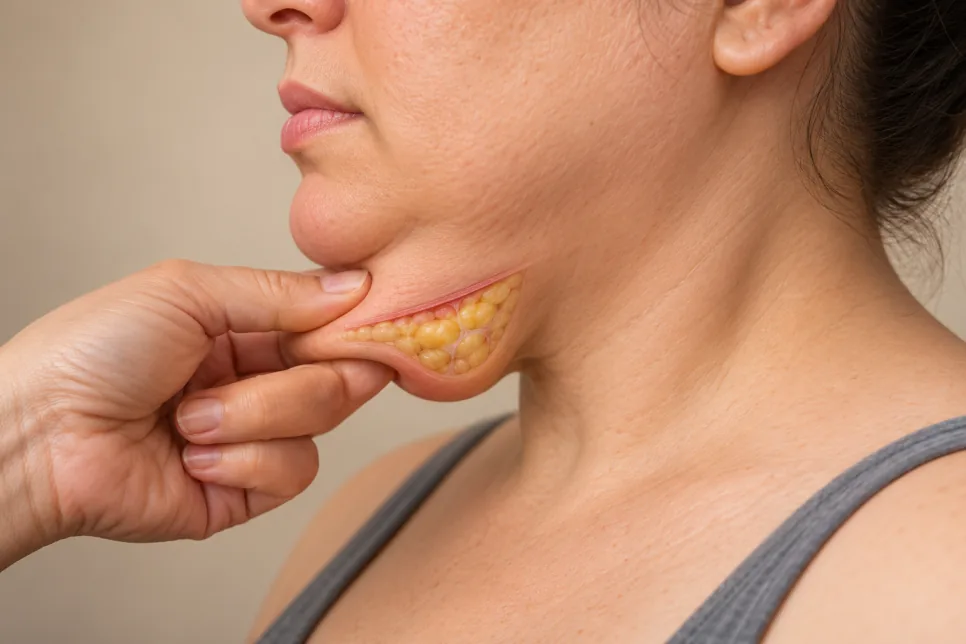
When fat under the chin is the cause, you can usually feel a soft, thick layer beneath the skin. Pinch the skin under your chin gently and it feels full between your fingers — the thicker the pinch, the larger the share of fat is likely to be. This type tends to stand out more when you gain weight, and even from the front, the jawline can look as if it curves down into a rounded shape.
That said, slim people can have fat under the chin too. Facial fat doesn't always come and go the same way body weight does, so some people are slim everywhere else but still have fullness under the chin. Your weight and your double chin don't necessarily move together.
What Does a Sagging Double Chin Look Like?
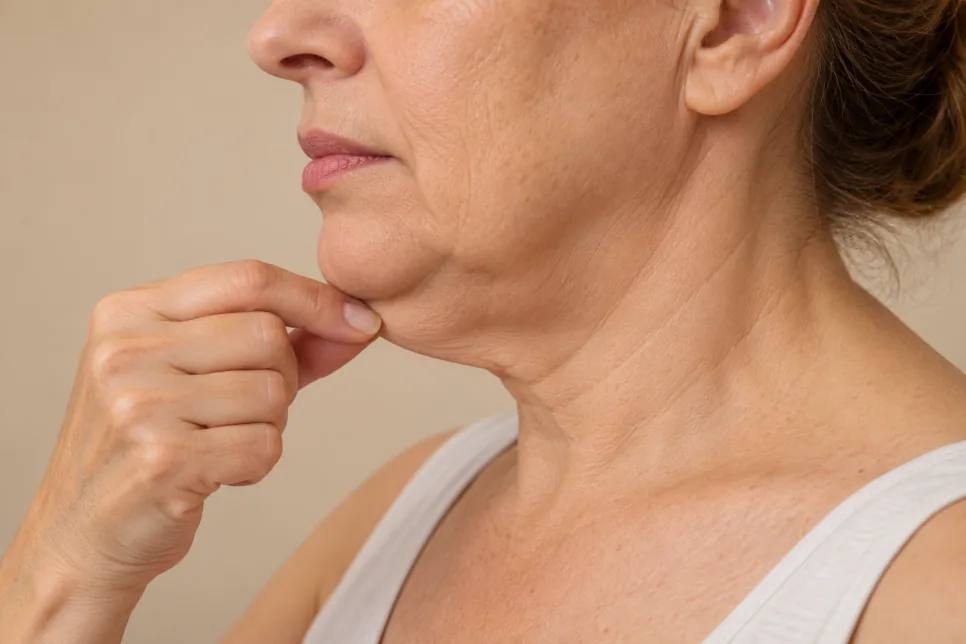
When sagging is the cause, what you notice first is looseness rather than thickness. Thin skin hanging below the jawline and creasing, or a blurred line where the jaw meets the neck, are the classic signs. Pinch the skin and you'll feel thin skin stretching rather than a thick layer.
As skin firmness and the face's supporting structures slowly weaken with age, the same amount of fat starts to sit lower. That's why many people who feel a double chin suddenly appeared haven't actually gained fat — the sagging has simply begun. If that sounds familiar, notice whether sagging around your mouth and cheeks bothers you as much as your jawline when you look in the mirror.
Is There an Easy Way to Check at Home?

A reliable answer comes from an in-person exam where your doctor can see and feel the area, but you can get a rough idea at home. The simplest check: stand comfortably facing forward and gently pinch the skin under your chin between your thumb and index finger. Notice whether it feels thick and full, or thin and stretchy.
Another check is to watch what happens as you change your head angle. If the fold under your chin almost disappears when you tilt your head up slightly, sagging or posture may be the bigger factor. If the fullness stays even with your head up, fat may be the bigger share. Taking a photo of your profile helps too, because the angle between your jaw and neck shows up clearly from the side in a way it doesn't from the front.
These checks are only a guide, though. Fat and sagging are often mixed together, so it's hard to pin it on one or the other yourself.
Can Anything Else Cause a Double Chin?
Sometimes other factors are hiding behind what looks like a double chin.
Jaw structure — if your chin is small or sits further back, the line between your jaw and neck can look soft and create a double chin even without much fat underneath.
Posture — if you tend to push your head forward while looking at your phone or computer for long periods, the skin under your chin folds and becomes more noticeable.
Puffiness and swelling — if the area under your chin looks puffy after a late dinner, too little sleep or salty food, it may just be a temporary change.
Because there are so many possible causes, two people with a similar-looking double chin may need quite different solutions.
How Does Treatment Differ by Cause?
If fat makes up most of it, an approach that reduces fat under the chin is worth considering. A fat-reducing contour injection targeted to that area is one example, and the number of sessions and the spacing between them can vary with the area and the amount of fat.
If sagging is the bigger part, a lifting-based approach that addresses both lost firmness and looseness can be considered. Here too, the right method depends on how much the skin has dropped, where, and how thick it is.
When both fat and sagging are present, which one you treat first matters. Reduce only the fat when the skin lacks firmness and you may be left with skin that looks loose; lift only the sagging when there's a lot of fat and the result may not be as neat as you'd hoped. That's why no single method suits every double chin.
Summary
A double chin is made up of fat, sagging, jaw structure, posture and puffiness, layered in different proportions for each person. Pinching the skin or changing your head angle at home can give you a rough idea, but an accurate assessment needs an in-person exam. Knowing the cause first cuts out unnecessary trial and error and makes it clearer which direction is right for you. If the area under your chin has bothered you for a while, it's worth seeing a doctor to check where things stand.
This article is general information about the treatment and does not replace an individual diagnosis or treatment plan. Results and their duration vary from person to person.
Wondering what would suit you?
Whether a treatment suits you, and how to plan it, is best decided with a doctor.