

Lifting / DAYONE
Reading the contours, finding the right depth.
When cheek and jawline sagging concerns you.
View treatment summary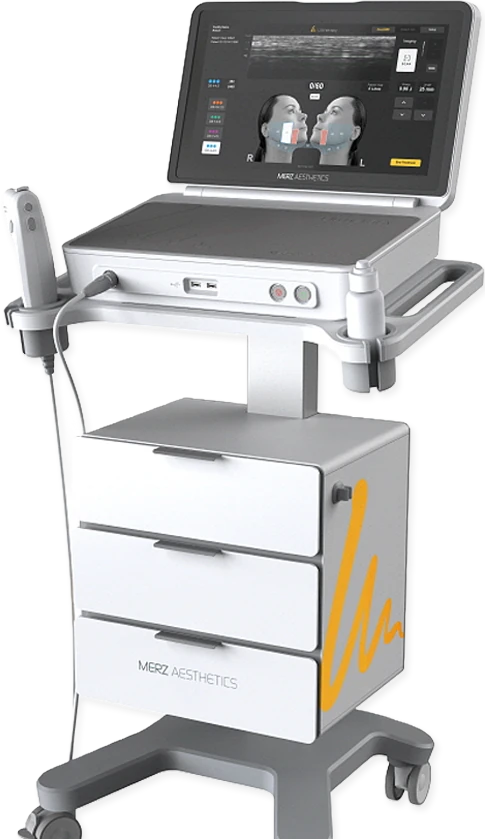
(01)AT A GLANCE
The treatment's role
Ultherapy is a device that lifts the face for a slimmer appearance. At DAYONE Clinic, we place importance on lifting the face without hollowing the cheeks, through consultation with a doctor.
Suitability, methods, and expected changes vary by person.(02)YOUR CONCERN
From the small changes you notice,
a consultation begins.
- 01
When cheek and jawline sagging concerns you
- 02
When some areas need lifting and others look hollow
- 03
When a plan suited to your face matters more than shot count
STRUCTURE BEFORE ENERGY
Whether treatment is needed is decided after consultation.
(03)UNDERSTANDING
The depth and thickness of supporting tissue and fat beneath the skin vary by area. It is important to assess the direction of sagging and distinguish hollow-looking areas.

Direction of sagging
We assess front and side views and moving expressions, distinguishing desired contours from current tissue condition.
We assess the desired contour alongside the actual tissue condition.
Remaining volume
We do not treat sagging and hollowing as the same concern. We assess remaining volume and surrounding balance.
Coverage and depth are considered separately for each area.
Skin firmness
We assess skin condition alongside facial contours. Treatment roles and order are decided in consultation.
Before adding treatment, we reassess whether the next step is needed.
(04)THE DAYONE APPROACH
Areas, coverage, and combinations with other treatments
are reviewed with your doctor for your current condition.
- 01OBSERVE
Depth assessed with imaging
We assess the desired contour alongside the actual tissue condition.
- 02DESIGN
Planning that distinguishes sagging from hollows
Coverage and depth are considered separately for each area.
- 03REVIEW
Shots allocated where needed
Before adding treatment, we reassess whether the next step is needed.
(05)BEFORE & AFTER YOUR VISIT
Recovery planning
Thread and device treatments have different recovery processes. Swelling, bruising, or discomfort may occur, so tell us about important plans in advance. We discuss recovery time according to the method and area.
Tell us before your visit
Tell us about past treatments, medications, and health status. Also mention important plans and available visit dates.
Aftercare and how to contact usFrom consultation to follow-up
01 Consultation and assessment
We listen to your goals and previous experiences, then assess your current condition.
02 Planning and treatment
We explain the scope, method and expected reactions, then proceed according to the plan.
03 Follow-up
We review recovery and changes to consider whether further care is needed.
(06)FROM THE CONSULTING ROOM
Thinking about Ultherapy? Start with this conversation.
Before deciding, explore the doctor's perspective through their explanation. Video cases and individual outcomes may differ.
Watch the doctor's explanation(07)BEFORE YOU DECIDE
Specific explanations about your condition and plan
continue in consultation with your doctor.
01How do Ultherapy and Thermage differ?+
Ultherapy primarily uses ultrasound to lift the face for a slimmer appearance, while Thermage uses radiofrequency energy to renew the skin. Ultherapy provides lifting but has little effect on skin quality itself, while Thermage improves the skin but has a weaker lifting effect. They are complementary devices rather than competing ones.
02How much pain or discomfort should I expect?+
Ultherapy feels similar to needle pricks, while Thermage feels hot. As Thermage generally takes longer, topical anesthesia is often sufficient for Ultherapy, while sedation is usually recommended for Thermage.
03How should I plan recovery and daily activities?+
You can return to everyday activities immediately after either treatment. There may be very slight swelling, but usually no visible signs on the skin surface.
04How long do results last?+
The effects of both Ultherapy and Thermage typically last about a year.
05How are session count and intervals decided?+
The recommended treatment interval is one year, but treatment every six months is also an option.
06Can I combine this with other treatments?+
Both Ultherapy and Thermage can be combined with any other treatment on the same day.