

Women who look great in their 40s know that blotchy, uneven skin tone ages a face more than any single wrinkle—so they manage it with sun protection, hydration, and smart wardrobe colors. A dermatologist breaks down the essentials of skin tone care in your 40s.

Hello from DAYONE Clinic. When I see patients these days, I’m struck by how different people in their 40s and 50s are from a generation ago. More and more of them look so much younger and more polished that I’m genuinely surprised when they tell me their age.
These people have something in common. They aren’t straining to look young by competing with twentysomethings, and they don’t blindly follow every trending treatment. They know exactly how the face changes with age and how to care for it as it does.

Today I want to talk, as a dermatologist, about the first thing attractive women in their 40s tend to focus on: skin tone.
Uneven skin tone ages you more than a single wrinkle
Many patients tell me, “I’d look younger if I could just get rid of my smile lines,” or “The lines around my eyes bother me most.” But when you look at the face as a whole, blotchy skin tone and pigmentation actually make someone look older than a single wrinkle does.
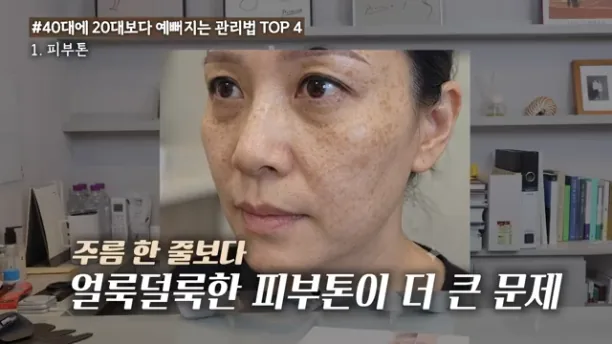
Even with a few fine lines, skin with an even tone and a clear, smooth texture looks far more put-together and refined. There’s even research showing that pigmentation, more than wrinkles, is what makes a face look older.
The attractive women in their 40s I see in my practice understand this distinction. Instead of writing it off as an unavoidable part of getting older, they take care of the melasma, discoloration, and sun spots they already have in a way that suits their own skin.
How skin tone care should change in your 40s
Starting in your 40s, melasma, discoloration, sun spots, and other things that make skin color uneven become more common, and as texture gets rougher, the whole face can easily look dull. Here’s how women who look great in their 40s actually handle it. Because pigmentation tends to stand out along the border between the face and neck, they apply sunscreen carefully below the jawline and down onto the neck.

Instead of gritty scrubs or exfoliating towels, they protect their skin barrier by layering on hydration two or three extra times. And as a dermatologist, I’ll add one more thing: these women also make good use of clothing colors that brighten their complexion. On days when their skin tends to look dull, they avoid muddy grays and beiges for tops and underlayers, and instead wear bright ivory or off-white right at the neckline for a natural reflected-light effect.
The takeaway

Ultimately, what these women share is knowing exactly what makes their complexion look its best. The key isn’t erasing every wrinkle one by one—it’s caring for your skin so that your tone, texture, and overall impression all look clean and fresh.
In my next post, I’ll continue with posture and the overall impression you project. If you have any questions, feel free to reach out to DAYONE Clinic near Gangnam Station anytime.
This post is adapted from an interview on DAYONE Clinic’s YouTube channel, Face Design Lab.
This article is general information about the treatment and does not replace an individual diagnosis or treatment plan. Results and their duration vary from person to person.
Wondering what would suit you?
Whether a treatment suits you, and how to plan it, is best decided with a doctor.