

Which treatments suit the most common type of smile lines, caused by lost elasticity, and the excess-fat type, where filler should never come first. Also explains how filler differs from Juvelook and the daily care to prioritize before any treatment.

This article is adapted from an interview on Face Design Lab, DAYONE Clinic’s YouTube channel.
Hello from DAYONE Clinic. For the laxity type, we combine Ultherapy or Shurink with Juvelook; for the excess-fat type, we reduce the fat first with InMode or ONDA. In the previous two articles, we covered home care for smile lines and filler for the structural type. This time I’ll look in detail at the smile line lifting treatments that suit the laxity and excess-fat types.
Type 2: Laxity
The laxity type, where lines form as tissue sags downward, is probably the type most people have. Here, lifting comes before filling. HIFU (high-intensity focused ultrasound) lifting devices like Ultherapy and Shurink are worth considering. They work by retightening the loosened retaining ligaments beneath the skin to put sagging tissue back in place.
On top of that, with the laxity type, combining lifting with a collagen-stimulating injection like Juvelook works better than lifting alone. As collagen fills in, the skin itself thickens and gains overall elasticity, so it looks much firmer. I have these device treatments myself once or twice a year as maintenance, and in photos I could clearly see that my facial contours looked more defined.
Filler vs Juvelook
Many people ask, “Aren’t filler and Juvelook both treatments that add volume?” That’s partly right, but they’re completely different in nature.

Filler adds volume immediately with a substance introduced from outside, while Juvelook prompts your skin to produce its own collagen. So filler shows results right after treatment, but if the amount isn’t right, it can look a bit artificial. Collagen-stimulating substances like Juvelook, Sculptra and Radiesse, on the other hand, work by letting your own tissue fill in rather than creating volume artificially, so they look much more natural.
Another advantage is that skin texture improves over time. Keep in mind, though, that collagen takes at least a month to form, and if skin aging is already advanced, collagen may not form well even with Juvelook. People who dislike the foreign-body feel or unnatural look of filler tend to be much happier with these collagen-stimulating injections.
Type 3: Excess Fat
I’d like you to pay especially close attention to the third type.
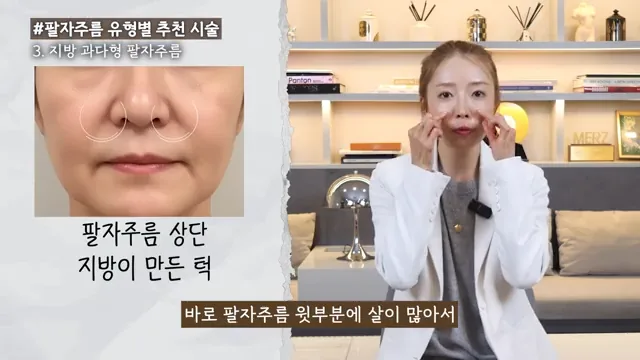
This is the excess-fat type, where there’s a lot of fat above the smile line, making it stand out. If this is you, you should definitely avoid starting with filler. Adding more to an area that’s already heavy makes the face look bigger and only sharpens the edge of the line.
In this case, the right order is to reduce the sagging fat first with treatments like InMode or ONDA. Once unnecessary fat is reduced to lower the bulge above the line, a thread lift or device treatment smooths the facial contour. Please remember that treatment isn’t about erasing a single line; it’s a process of balancing the contour of the whole face.
Three-Part Series Summary
Over three articles, we’ve looked at ways to reduce smile lines. Here are the key points.
Home care
The “ee” exercise to strengthen the upper cheek muscles
Releasing the modiolus fascia from inside the mouth
Stretching in the opposite direction
Nasalis massage
Temple fascia lifting
Habit to avoid
No crash dieting
Treatments by type
Structural (sunken base beside the nose): a minimal amount of filler
Laxity (sagging): Ultherapy or Shurink combined with Juvelook
Excess fat: reduce fat first with InMode or ONDA, then a thread lift or device treatment
Final Thoughts

I’ve covered treatments too, but honestly, daily care comes first. Even with an expensive treatment, if the habits that deepen smile lines stay the same, results will be weaker or won’t last as long. So starting today, I recommend doing the face yoga and fascia massage from these articles whenever you have a moment. Once you see your face shape change through your own effort, without spending a lot, care will start to feel less like a chore and more like a pleasure.
I hope these three articles help anyone bothered by smile lines. If you’re considering smile line lifting or have any questions, feel free to ask us at DAYONE Clinic near Gangnam Station. Thank you.
This article is general information about the treatment and does not replace an individual diagnosis or treatment plan. Results and their duration vary from person to person.
Wondering what would suit you?
Whether a treatment suits you, and how to plan it, is best decided with a doctor.