

Sagging along the jawline, around the mouth, and around the eyes often comes from the same overall loss of facial support, so pinning down the cause matters more than choosing a treatment by name. Here’s when a thread lift makes sense and where its limits lie, what we look at during a consultation, and what to expect afterward.
Hello from DAYONE Clinic. At some point, you may look in the mirror and realize your face doesn’t look quite the way it used to. Your jawline has blurred and your lower face looks heavier. The outer corners of your eyes and the area around your eyelids have settled lower, making you look tired. And the lines around your mouth look deep even when you’re not making any expression.
So many people start searching for lifting treatments and come in asking, “Will this help with sagging like mine?” What most of them want isn’t a completely different face—it’s their own face, looking softer and more youthful. But sagging and wrinkles don’t come from just one cause, so there are a few things to look at before deciding on a specific treatment.

Why does your whole face seem to be sliding down?
With age, the skin loses collagen and elastic fibers—and the fat layer, fascia, and ligaments beneath it that hold the face up lose their supporting strength as well.
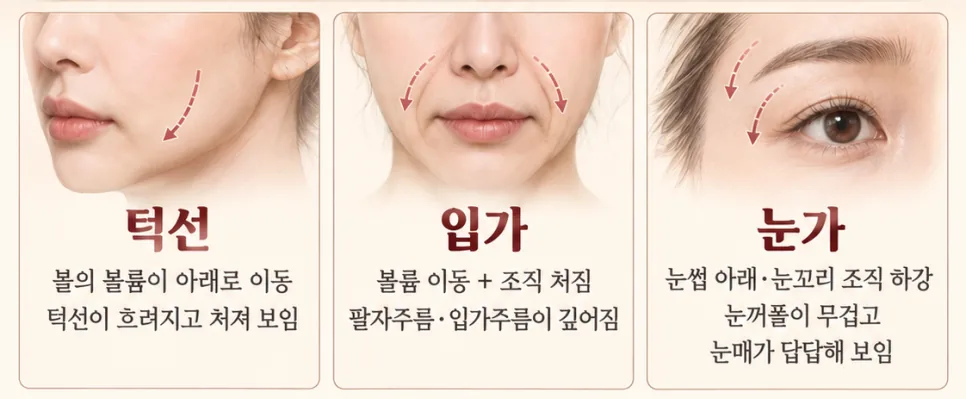
As this support structure loosens, volume that used to sit in the cheeks moves downward. The jawline starts to lose its shape, and smile lines (nasolabial folds) and the lines around the mouth become more deeply etched.
The eye area is no different. When the tissue beneath the brows and at the outer corners of the eyes descends, the eyelids can look heavy and the eyes can look hooded—even when the eyelid skin itself isn’t the problem. So while changes along the jawline, around the mouth, and around the eyes may look like separate problems, they often appear together as part of a single shift: a change in how well the whole face is supported.
Is it just about skin elasticity?

Often, it isn’t. The approach can differ depending on whether the skin has lost elasticity, volume has shifted, or habitual expressions and muscle tension are affecting how you look.
Even smile lines that look alike can have different origins: some form because the skin has thinned, others because tissue from the cheeks has moved down. In the first case, the focus may be on improving skin texture and elasticity; in the second, on supporting the tissue that has descended. Using the same approach without making this distinction can lead to results that differ from what you expected, which is why identifying the cause comes first.
When is a thread lift worth considering?
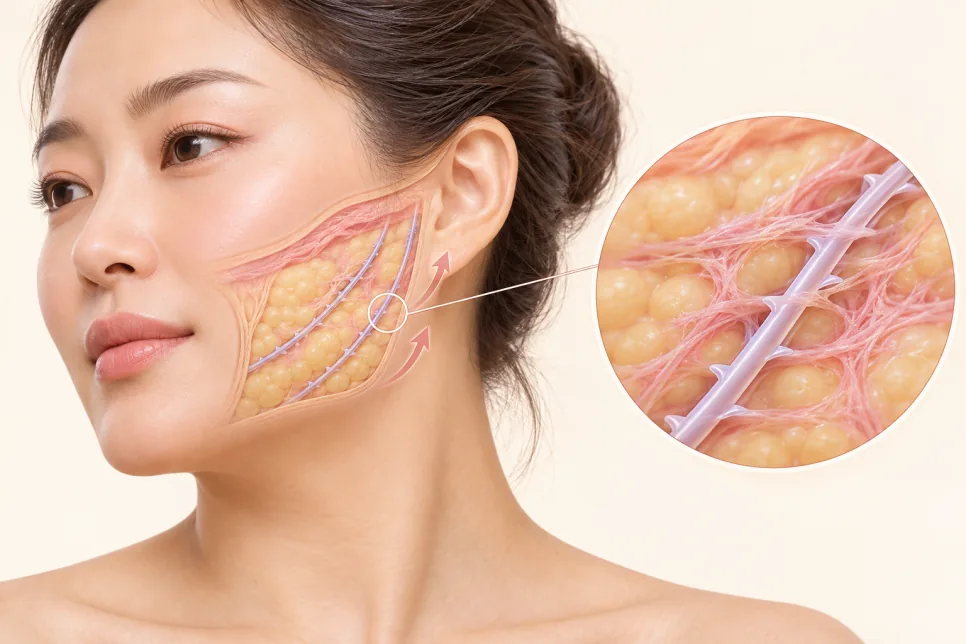
In a thread lift, fine threads are placed beneath the skin to support sagging tissue, and as the threads settle in, they stimulate a response in the surrounding tissue. It may be worth considering when the sagging is in a fairly well-defined area and the tissue needs support—but you can’t expect the same effect for every kind of sagging.
The eyelids in particular call for careful evaluation. If sagging below the brows or at the outer corners of the eyes is what’s weighing the eyelids down, supporting the surrounding area may be an option. But if there’s a lot of excess eyelid skin, a thread lift alone may not be able to address it. That’s why you need an honest assessment of which areas are sagging and by how much, and what a thread lift can realistically be expected to do.
What does the DAYONE Clinic medical team look at?
At DAYONE Clinic, rather than recommending a treatment first, we begin by taking a thorough look at your face as it is now. We check the thickness and elasticity of your skin, which area—jawline, mouth, or eyes—shows the most noticeable sagging, and how balanced your face looks overall from the front and in profile. We also compare how your face looks when you make expressions and when it’s relaxed.
We then hear which area concerns you most and how much change you’re hoping for, and together we settle on a degree of change that looks natural and can be maintained. That’s because the change you want and the change that suits your face aren’t always the same.
Does lifting always mean pulling tight?
No. In fact, an overly pulled look can make your expressions seem unnatural and make you look less like yourself. With lifting after 50, the goal isn’t to make you look younger—it’s to smooth out lines that have broken down, naturally, without compromising the look you have now.
Refining things just enough—a slightly crisper jawline, a more relaxed mouth area, eyes that look less tired—may also be the kind of change you’ll stay happy with longer. Your face stays your own; your expression simply looks softer, and you look younger as a result. That’s the change DAYONE aims for.
Is a thread lift enough on its own?
When sagging and wrinkles occur together, we usually look at several options based on your condition rather than relying on a single treatment. A thread lift may be considered to support sagging tissue; laser lifting or a skin booster for overall loss of skin elasticity; filler when lost volume is creating lines and shadows; and Botox for wrinkles deepened by habitual expressions.
That said, layering on more treatments doesn’t necessarily mean a better result. We consider pinpointing what you really need right now—and choosing not to do treatments that can wait—part of the consultation.
What to expect after treatment

After a thread lift, you may have temporary swelling, bruising, a feeling of tightness, or discomfort; how much and for how long varies from person to person. That’s why it’s best to have all of this explained—and to understand it—before you decide.
At DAYONE, we don’t see the day of your procedure as the finish line. We treat the entire period until your face settles as one process: checking how the results are settling in, watching for any asymmetry or discomfort, and following up with a touch-up if needed. That’s how we practice.
The bottom line

If you’re researching thread lifts, changes in your jawline, eyes, and mouth may have been bothering you for quite a while. Before you focus on treatment names, it helps to sort out a few things: which area bothers you most, when you first felt it had changed, and how much change you want. With those answers in hand, your consultation can be far more specific.
Whether you need a thread lift or another approach would suit you better, we can only recommend what’s right for you after assessing your condition in person. We suggest starting with a consultation to find out what kind of change you need right now.

This article is general information about the treatment and does not replace an individual diagnosis or treatment plan. Results and their duration vary from person to person.
Wondering what would suit you?
Whether a treatment suits you, and how to plan it, is best decided with a doctor.