

Ultherapy shouldn't simply be turned up as high as possible. The energy level needs to match your skin thickness, and how carefully the doctor handles the transducer's angle and pressure shapes the result. We cover Ultherapy PRIME, the new device with much less pain, along with four key points for better Ultherapy results.

This article is adapted from an interview on DAYONE Clinic's YouTube channel, Face Design Lab.
Hello from DAYONE Clinic. In the last two articles, we covered tailored Ultherapy planning, line counts and transducer combinations. This time, we'll look at how energy levels are adjusted and introduce the new device, Ultherapy PRIME. Ultherapy PRIME is the first new model in 15 years, with more precise energy output and much less pain.
More Pain Doesn't Mean Better Results
The fourth key is the energy level. Ultherapy offers energy levels from 1 to 4. Many people say, “Doctor, turn it up. It has to hurt to work, right?” But that's a rather risky idea.
Stronger isn't better; the key is finding the level that's right for your skin thickness. What happens if someone with thin skin is treated at too high a level? The ultrasound can reduce too much of the fat layer, and here too, side effects such as hollow cheeks can occur. Though rare, excessive energy delivered to shallow areas where nerves run can also damage those nerves.
Low vs. High Energy Levels
People also ask, “But if I get it at a low level, won't it do nothing?” It's better to think of it as low energy where low is enough, and high energy where high is needed.

As we've said several times, it's essential to lower the level where the skin is thin or there's little fat, and raise it to deliver enough energy where fat is thicker, such as a double chin.
Adjusting in Real Time with Ultrasound Imaging
To do that, the doctor needs to check ultrasound images in real time throughout the treatment and fine-tune as they go: “The skin is thin here, so lower it; it's thicker here, so turn it up a little.” Here's something interesting: with enough lines, treatment at a low level alone can still give good results. 500 lines at a standard level is more effective than 300 lines at a high level, and the risk of side effects is actually lower.
The Doctor's Hand Technique Shapes the Results

The fifth key is the doctor's hand technique: the angle of the transducer and the pressure applied. It may seem minor, but it makes a big difference. If the angle is even slightly off when the transducer touches the skin, the focus shifts, so the energy may not be delivered properly or may burn the wrong layer.
Rather than placing the device on the face and repeating the same motion, the doctor has to adjust carefully at every moment, so doing this precisely and skillfully takes plenty of treatment experience.

Ultherapy PRIME Greatly Reduces Pain
The sixth and final key is for those who've put off Ultherapy because of pain: try the new device.

Recently, Ultherapy was upgraded for the first time in 15 years, and a new device called Ultherapy PRIME was released. Its energy output is more precise than the original, allowing much finer treatment. The most welcome change is that the pain has been greatly reduced.
Ultherapy works well but is quite painful, so a fair number of people said after one session, “I can never do that again.” Now the pain is much lower, enough to feel quite bearable.
The Doctor's Own Experience
People also ask, “So, Doctor, have you had it yourself?” Of course. I had it as soon as the device came out.
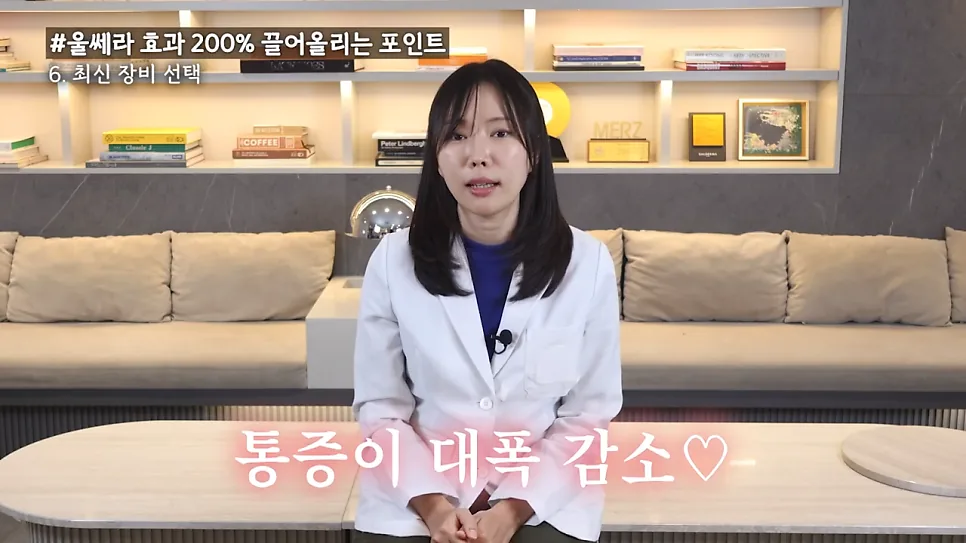
I could clearly feel that it hurt less than before. The treatment was also faster, so the time spent in discomfort was shorter, which made it feel much easier.
So if worry about pain has kept you from Ultherapy, choosing the upgraded device is a good way to get both results and comfort. Of course, the doctor's skill matters more than the device.
Key Points for Better Ultherapy Results
Across these three articles, we've covered all the key points for getting the most out of Ultherapy. Remember these four.
First, get a plan tailored to your face shape and fat distribution.
Second, rather than simply adding more lines, distribute a line count that suits your face size.
Third, use all three transducers (4.5 mm, 3 mm and 1.5 mm) evenly.
Fourth, fine-tune the energy level to your skin thickness.
Add consistent aftercare such as sun protection and moisturizing, and you'll be even closer to a result that's worth what you spent.
Summary
Remember that Ultherapy results vary greatly depending on who performs the treatment. At your consultation, go through the points in this article one by one, and in particular check whether the clinic uses the latest device such as Ultherapy PRIME, uses all three transducers and adjusts the energy level in real time. If you have any questions, feel free to contact DAYONE Clinic near Gangnam Station. Thank you.
This article is general information about the treatment and does not replace an individual diagnosis or treatment plan. Results and their duration vary from person to person.
Wondering what would suit you?
Whether a treatment suits you, and how to plan it, is best decided with a doctor.