

To make lifting results last longer, first fix habits like sleeping on your side and chewing on one side, then add facial exercises at home. Here's an exercise to wake up the cheek muscles, a platysma stretch and what to watch out for as you follow along.

This article is adapted from an interview on DAYONE Clinic's YouTube channel, Face Design Lab.
Hello from DAYONE Clinic. In the previous article, we explained that the reason lifting results fade quickly often lies in the muscles. Since then, many people have asked, “How do I balance my facial muscles? Is there a treatment for that?”
Treatments can help in some cases, but the first things to take care of are your daily habits and facial exercises at home. In this article, we'll go through ways to care for your facial muscles one by one.
Habits That Undo Your Treatment Results
First, check whether your habits are undoing the results of a treatment you paid good money for. More people than you'd think are harming their face with the way they sleep. Do you usually sleep on your side? Then one side of your face spends the night pressed into the pillow.

It's not only the skin that gets pressed. The cheek muscles are pushed toward the nose, and force is applied all night in the direction the nasolabial fold creases. Imagine that going on for six or seven hours. Instead of ironing wrinkles out, you're ironing them in every night. So it's best to get into the habit of sleeping on your back whenever you can.
Chewing on One Side and Facial Asymmetry
How you chew matters too. If you tend to chew only with the back teeth on one side, your face can very easily become asymmetrical.
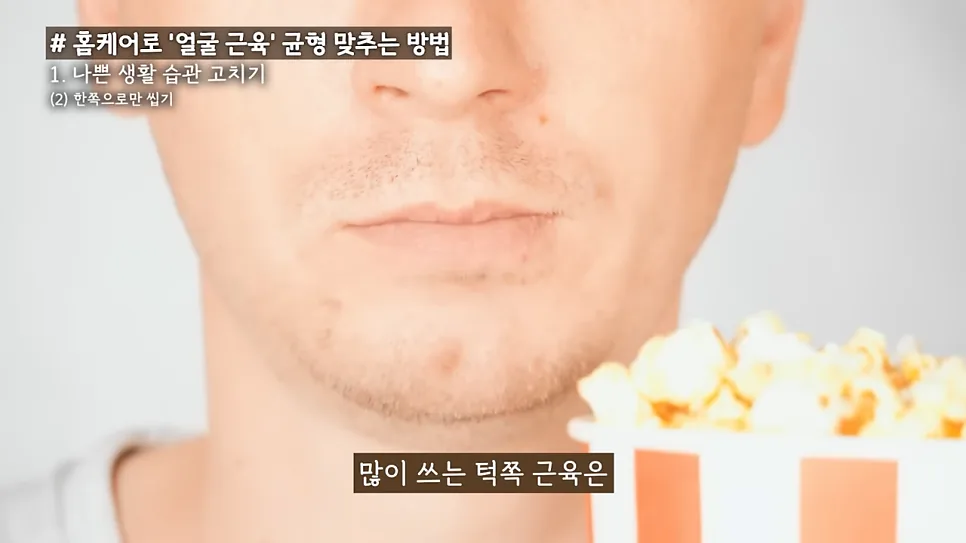
The jaw muscle on the side you use more grows as if it's been strength training, while the other side weakens, making the jaw look as if it has shifted to one side. If you keep this habit and only get a lift, your face is likely to drift back to where it was.
So if you often frown, love chewing hard foods or sleep on your side, fix those habits first. That said, keeping a blank expression all the time to avoid using your face weakens the muscles overall and can actually make sagging worse.
Correct bad expression or eating habits, but smile and talk naturally. Adding facial exercises on top of that makes the effect even greater.
Exercise to Wake Up Weakened Muscles
I do these facial exercises myself every day, on the drive home after clinic and when I wash my face in the morning. I'll go through them one at a time, so follow along in front of a mirror.
The first exercise wakes up weakened muscles. Earlier, we mentioned that sagging cheek muscles can deepen the nasolabial folds, and this movement helps lift that area. Smile as if you're saying “eee,” pulling the corners of your mouth toward your ears.

The key is to put the effort into your cheeks. Smiling with your eyes only deepens crow's feet, so don't smile with your eyes. Focus on lifting your cheeks upward.
If your cheek muscles are quite weak, lifting just the cheeks may not be easy at first. In that case, practice while supporting your cheeks with your palms, and once you get the feel of it, hold the position for 10 seconds. Do five reps at a time, and repeat whenever you have a moment.
Changes in Expression and Overall Look
Exercises like this also help improve your overall look by correcting how you use your expression muscles. When someone who has overused the muscles around the mouth starts using the cheek muscles, a smile that only pulled the mouth corners sideways often becomes softer and more natural, and the whole face looks brighter.
It's the same reason someone who rarely smiles looks awkward when suddenly asked to smile, because their muscles are stiff, while a person who smiles often has a natural, pleasant smile.
Exercise to Release Tight Muscles
The second exercise releases tight muscles. You lower your head when you look at your smartphone, right? That shortens the platysma, the thin muscle running from under the jaw down to the neck, and it pulls the whole face downward.
When this happens over and over, the jawline can blur and the whole face can sag. For the face to lift, the platysma needs to be released.

Place both hands on your collarbones and press down gently. Then slowly tilt your head back and look up at the ceiling. You should feel the front of your neck stretch tight.
From here, push your chin out toward the ceiling. Pursing your lips into an “oo” shape makes the stretch much stronger and lengthens the platysma. Hold for about 30 seconds.
Doing this regularly as well can reduce the downward pull on your face, for a noticeably slimmer jawline.
Better Posture
This exercise doesn't just release the muscles; it also helps correct your posture. If you spend long hours on your phone or at a computer, try it often throughout the day. Besides your facial contours, you may notice a stiff neck or sore shoulders feel much better.
Precautions When Exercising
Some people ask, “I've heard of people whose wrinkles got deeper after following facial exercises on YouTube. Is there anything I should be careful about?” Putting too much force where it isn't needed can create wrinkles in the wrong places.
As mentioned earlier, apply force only where it's meant to go. It's the same principle as working out: if you engage your lower back when your glutes or thighs should be doing the work, you can hurt your back. That's why it's most accurate to always use a mirror at first.
Summary
Start by fixing your daily habits, then keep up the facial exercises from this article. In the next article, we'll cover lifting Botox, which helps when home care alone isn't enough. If you have any questions, feel free to contact DAYONE Clinic near Gangnam Station.
This article is general information about the treatment and does not replace an individual diagnosis or treatment plan. Results and their duration vary from person to person.
Wondering what would suit you?
Whether a treatment suits you, and how to plan it, is best decided with a doctor.