

Why do thread lift results differ so much from person to person? We break down how facial sagging happens and outline three face types that tend to respond well.

Hi, this is DAYONE Clinic. Have you ever looked at a group photo from a get-together and thought, “My jawline is completely gone—maybe I should get a thread lift?”
But if you look at people who’ve had a thread lift, the results are all over the place. Some are happy that their facial contours look crisper and more defined; others feel they didn’t get as much lift as they expected, or that it didn’t last as long as they’d hoped. So today we’ll look at why results can feel so different from person to person, and which face types tend to respond well.
Facial sagging isn’t just about the skin
A tent is a useful way to picture why the face sags. When you’re young, your face is like a tent that’s been pitched nice and tight.
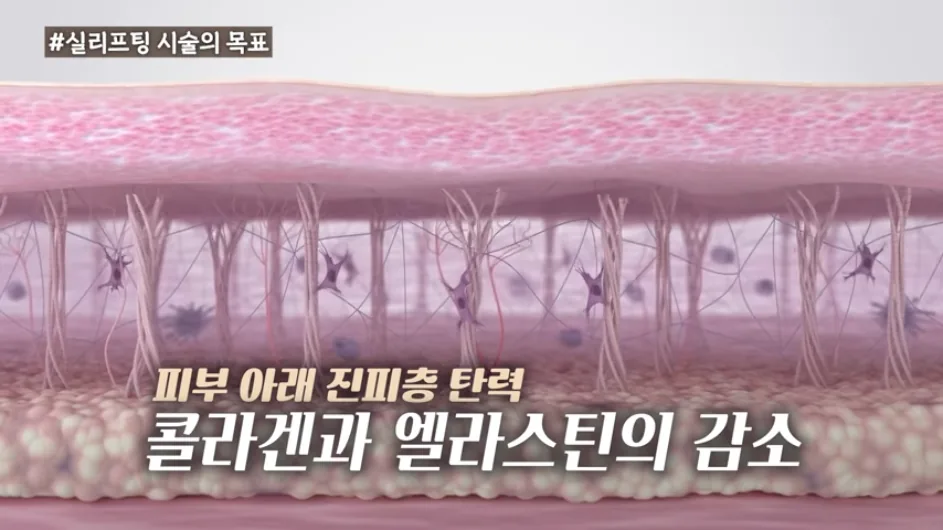
With age, though, the skin thins and droops as collagen and elastin decline. Fat deflates or slides downward. Ligaments and fascia lose their strength, like old, stretched-out rubber bands. As a result, some areas look hollow, some sag, and some look bunched up.
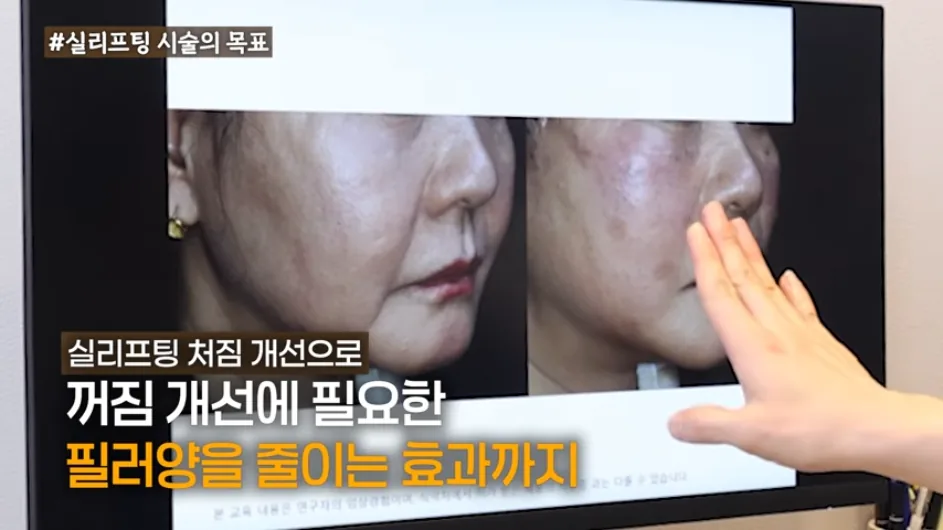
Hollow areas need volume; sagging areas need lifting. A thread lift handles the second part: threads catch tissue that has dropped and pull it up in the desired direction. If you lift the sagging volume that has gathered over the nasolabial folds and marionette lines, then fill hollow areas with a small amount of filler, you can get both effects at once while using less filler.
Three face types that tend to respond well

Type 1: Soft tissue, but a jawline that’s losing definition
This type has soft tissue that moves easily under your fingers, almost like modeling clay. Head-on, nothing looks especially wrong—but the moment you tip your head down slightly, your jawline seems to collapse and the fullness under your jaw spills over. Or you notice that photos seem to catch you with a double chin far more often than you’d expect. If that sounds familiar, you likely fall into this type.
Because the tissue hasn’t fully stiffened yet, simply repositioning the sagging tissue slightly upward can bring the hidden jawline back relatively quickly. This is the type that tends to report the highest satisfaction relative to the procedure.

Type 2: Extra heaviness above the smile lines and around the mouth
Here, the area over the cheekbones and the front of the cheeks actually looks hollow, while fullness bulges out just above the nasolabial folds and in the lower cheeks beside the mouth. This happens when fat that should sit higher on the face shifts downward in clumps with age.
If people tell you that you look angry or grumpy when your face is relaxed, you may be closer to this type. Shifting that sagging fat back toward the hollow front of the cheeks can slim the lower face and restore volume higher up—two effects at once.

Type 3: Loose skin after rapid weight loss or childbirth
This is when the skin couldn’t keep up as the weight came off, and it ended up sagging. In many cases, the cells responsible for skin elasticity are still healthy, so pulling the loose skin from underneath and anchoring it lets the tissue settle into place, and the skin can feel as if it has tightened back down. That said, results vary from person to person depending on skin age and elasticity.
The bottom line
With a thread lift, both the approach and the results vary significantly by face type. Start by using the self-assessment in our next post to see which type you might be. For an accurate diagnosis, we recommend visiting DAYONE Clinic near Gangnam Station for a consultation with a physician. If you have any questions, feel free to reach out anytime.
This post is adapted from an interview on DAYONE Clinic’s YouTube channel, Face Design Lab.
This article is general information about the treatment and does not replace an individual diagnosis or treatment plan. Results and their duration vary from person to person.
Wondering what would suit you?
Whether a treatment suits you, and how to plan it, is best decided with a doctor.