

Botox for dynamic wrinkles, filler for deep static lines and Re2O when skin structure has broken down: three eye-wrinkle treatments we recommend and how to pick.

This article is adapted from an interview on Face Design Lab, DAYONE Clinic's YouTube channel.
Hello from DAYONE Clinic. When at-home care isn't enough for wrinkles around the eyes, the three treatments we confidently recommend at DAYONE Clinic at Gangnam Station are Botox, wrinkle filler and Re2O. If you've been unsure which to choose, here they are, along with how to pick the right one for your skin.
1. Botox: Best for Dynamic Wrinkles
For dynamic wrinkles, the ones that only show when you make an expression, we always recommend Botox first. These days, a lot of at-home massage tools, vibration devices and patches are advertised as alternatives to Botox.

To be frank, stopping the muscle itself from moving with devices like these is pharmacologically impossible. Botox works by blocking acetylcholine, a messenger chemical released at the nerve endings, so the muscle moves less. When the muscle stays still, wrinkles don't form. The effect usually lasts about three to four months.
Technique really matters, though. Placing injections too close can make your expressions look unnatural, and using too much can flatten the small roll of fullness just under the lash line (the pretarsal roll), which ends up making you look more tired.

The key is the right amount in the right spot. Botox does have a limit, though: it works less well on deep static wrinkles that have already set in. Even when the muscle is relaxed, the crease that's already formed stays.
2. Eye Wrinkle Filler: For Deep Static Wrinkles
Deep wrinkles that show even when your face is at rest need the crease itself to be filled. That's what wrinkle filler does.
Here's an important point. Filling a large amount at once, as with standard filler, can easily leave the eye area puffy or lumpy. The skin here is so thin that regular filler techniques shouldn't simply be applied as they are. That's why we recommend a very fine needle and small amounts, built up slowly over repeated passes.
It also works much better when combined with Botox.
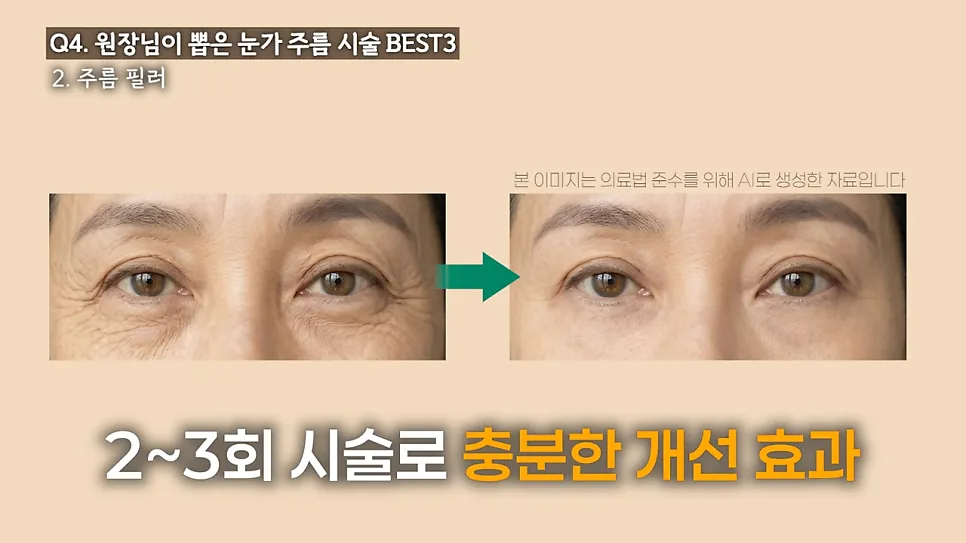
Wrinkle filler fills in the set crease, while Botox controls the muscle movement that would create it again. Combining the two gives a far more natural result that lasts longer.
3. Re2O: When the Skin's Structure Has Broken Down
Re2O is what we recommend if your skin has lost a lot of elasticity, the skin around your eyes looks crinkly and dull, or other treatments haven't lasted for you.

Re2O is a treatment that injects human-derived ECM (extracellular matrix) directly into the skin. ECM is the mesh-like structure in which collagen, elastin and hyaluronic acid intertwine to support the skin. Re2O works by replenishing this structure where it has broken down.

Because it's human-derived, it's highly biocompatible, with few allergic reactions, and it tends to be less painful than other skin boosters. We usually recommend three sessions, and increased dermal density and improved elasticity have been shown to last over the long term.
How to Choose the Right Treatment for You

Smile gently in front of a mirror.
Lines appear when you smile and disappear when you relax → dynamic wrinkles → Botox is the right fit
Deep lines are visible even at rest → static wrinkles → eye wrinkle filler is a good choice
Skin has lost a lot of elasticity overall and looks dull → Re2O is the right fit
These three treatments aren't an either-or choice, though. Depending on the patient, two or more are often combined.

Choosing the right combination means looking at the eye area, skin elasticity, wrinkle depth and even your expression patterns as a whole, so we recommend coming in for a thorough consultation with a doctor.
The Takeaway
Wrinkles around the eyes don't appear suddenly. They build up over many years. Even if it feels too late, today is still the earliest you can start. If you have any questions, feel free to get in touch anytime.
This article is general information about the treatment and does not replace an individual diagnosis or treatment plan. Results and their duration vary from person to person.
Wondering what would suit you?
Whether a treatment suits you, and how to plan it, is best decided with a doctor.