

For loss of firmness, Ultherapy or Shurink; for lost volume, dermal fillers or Sculptra; for severe sagging, a thread lift. Regular home care helps results last.

This article is based on an interview from Face Design Lab, DAYONE Clinic's YouTube channel.
Hello from DAYONE Clinic. In the last two posts I covered self-lifting techniques and the habits that make your face sag. Today I'll go through, by skin condition, the lifting treatments worth considering when home care isn't enough.
1. Ultherapy or Shurink: For Significant Loss of Firmness
If I sort my recommendations by skin condition, the first group is people whose skin isn't as firm as it used to be, or whose sagging has progressed to the point that their facial contours have lost their shape. For them, I recommend energy-based lifting such as Ultherapy and Shurink.

These treatments use high-intensity focused ultrasound (HIFU) to heat the fascia layer deep beneath the skin. The loosened tissue contracts and tightens, and the skin on top lifts and firms with it. Among energy-based lifting treatments, think of these as the ones with the strongest lifting effect.
Thin Cheeks? Design Matters
Because the effect is so strong, though, people with very little cheek fat need a carefully designed treatment. When the fascia layer is heated, too much energy in an area that's already hollow can make it look even more sunken. That's the hollow-cheek side effect people talk about.
So don't get Ultherapy just because everyone else is. Start with a thorough consultation about whether your skin really needs Ultherapy and how the treatment should be designed.

Ultherapy also isn't better just because it's stronger. The intensity has to be adjusted properly, at the right depth, only in the areas that need it. It takes a lot of experience to make those fine adjustments well.
2. Dermal Fillers or Sculptra: For Significant Volume Loss
Next, for people whose main issue is hollowing rather than sagging, I recommend volume treatments, typically dermal fillers and Sculptra. Why bring up volume in a post about lifting? Because when people with significant volume loss have treatments such as fillers, Juvelook or Sculptra, they can expect a natural lifting effect from the restored volume.

Picture a tent. When the fabric is wrinkled, what happens if, instead of only pulling it from the top, you stand a pole up inside? The fabric pulls taut, right?
Your face works the same way. With age, fat is lost and bone is resorbed, leaving empty spaces that let the skin sink. Filling those spaces with something like filler or Sculptra restores volume, and the surrounding skin smooths out and lifts with it. This is called the tent effect.

Dermal Filler or Sculptra: Which Should You Choose?
People ask me, “Doctor, if fillers feel like too much, can I just use a collagen injection like Sculptra instead?” Not necessarily. It isn't black and white, as in “fillers are artificial and bad, collagen injections are always safe and good.”
When filler looks artificial, the problem usually isn't the filler itself but too much of it. Put just the right amount where it's needed and it hardly looks artificial at all. That said, products like Sculptra, which gradually build up your own tissue as collagen forms, do look really natural.

But Sculptra, Juvelook and similar products stimulate your body to make collagen rather than adding collagen directly, so it's hard to get the dramatic volume you'd see with filler. People with very significant hollowing may find these injections alone aren't quite enough.
Collagen production also varies from person to person. Young, healthy skin makes a lot of collagen in response to Sculptra, but skin with more advanced aging may not make as much. And because you have to wait at least one to two months for collagen to form, you can't expect an instant effect the way you can with filler.
So if you want instant results and your hollowing is especially significant, filler is more effective. If your hollowing isn't severe and your skin makes collagen well, a product like Sculptra will likely leave you much happier.

3. Thread Lift: For Severe Sagging
Finally, for people whose sagging is truly severe, I recommend a thread lift. Special medical threads are inserted under the skin to lift sagging tissue physically. Small barbs on the threads anchor the tissue and lift it upward.
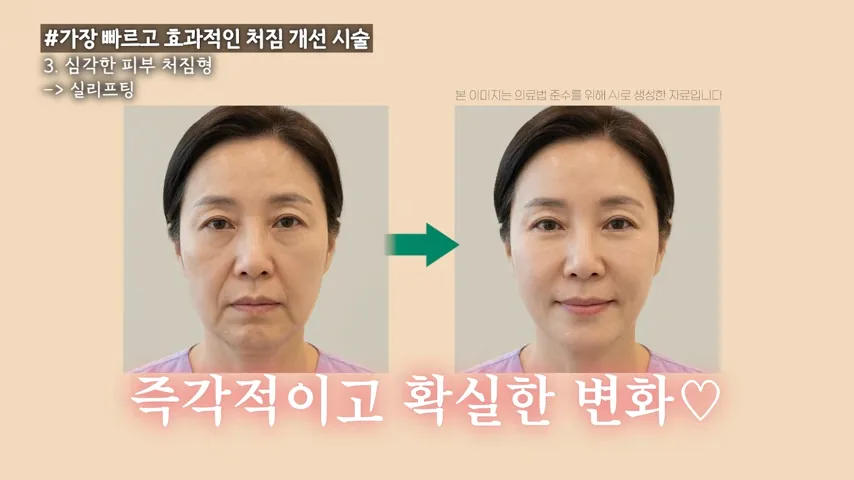
Because it's a physical method, its biggest advantage is a very immediate, clear change right after treatment. It's a common choice for people who have reached the limits of energy-based lifting like Ultherapy.
Thread Lift Side Effects and Precautions
People ask, “Lifting physically sounds a bit scary. Are there any side effects?” It's generally a safe treatment, but occasionally dimpling, where the skin looks a little uneven, can occur.
This tends to happen when threads are placed too superficially or pulled too tight, or when the skin is very thin. It usually settles with massage or on its own over time, but because so much depends on the doctor's skill, a thorough consultation is essential.

The Bottom Line
Let's quickly recap what we've covered over these three posts. To prevent sagging, the most important thing is to drop bad habits. A habitually blank expression, forward head posture, chewing on one side and not getting enough hydration all lead to sagging, so avoid them. Correcting your posture at home and combining face yoga with massage makes the improvement much greater.
If sagging has already gone too far for home care alone, here's what I recommend:
Significant loss of firmness — Ultherapy or Shurink (watch for hollow cheeks; design matters)
Significant volume loss — dermal fillers or Sculptra (instant results vs. a natural look)
Severe sagging — thread lift (physical lifting; skill matters)
But the most important thing isn't getting one treatment done right. If you keep up your home care, any treatment you have will work much better and last longer.

Even if you don't see a difference right away, remember that consistent care is what changes how you'll look five and ten years from now. I hope this three-part series has helped a little with your concerns about sagging.
If you have any questions or concerns, feel free to contact DAYONE Clinic near Gangnam Station. We've also covered this topic on our YouTube channel, Face Design Lab, so take a look. Thank you.
This article is general information about the treatment and does not replace an individual diagnosis or treatment plan. Results and their duration vary from person to person.
Wondering what would suit you?
Whether a treatment suits you, and how to plan it, is best decided with a doctor.