

With Ultherapy, results depend less on adding more lines (shots) and more on distributing them to suit your face size and condition, and on how the three transducers, 1.5 mm, 3 mm and 4.5 mm, are combined. We also explain whether it's okay to have Ultherapy after fat grafting.

This article is adapted from an interview on DAYONE Clinic's YouTube channel, Face Design Lab.
Hello from DAYONE Clinic. A full face usually takes around 600 Ultherapy lines (what Korean clinics call shots), and 800–1,000 if your skin is thick or neck lines are treated too, but how the lines are distributed and which transducers are combined matter more than the number. In the previous article, we talked about why Ultherapy also needs a plan tailored to each person. Since then, we've been asked this a lot: “At a consultation, the coordinator told me, ‘300 shots won't do much, you need as many as possible.’ Is that true?”
It's half right and half wrong, because the number of lines needed differs from person to person. In this article, we'll go through line counts and transducer combinations, the most important parts of a lift, in detail.
More Lines Isn't the Whole Story
To get the most out of Ultherapy, planning the right number of lines for your face matters far more than simply adding more. A full-face treatment usually uses around 600 lines. To treat thick skin or neck lines as well, it can go up to 800, or as many as 1,000.
But more lines aren't always better. The key is distribution. You need to calculate the minimum each area truly needs, so that no single line is wasted.

That means dividing precisely what each target area needs, for example 100 lines for a double chin, 100 for the lower cheeks and 100 around the eyes.
Principles for Increasing the Line Count
Even when increasing the number of lines, results improve only when it's balanced against the size of the face and the amount of fat, not just the number. A person with a small face getting 1,000 lines won't get better results than someone with a larger face, and excessive stimulation can even cause side effects.
The most common mistake people make when considering a lift is thinking, “If I just get a lot, it'll work.” Finding the right number of lines for your face size and condition is far more important.

How Transducer Combinations Make a Difference
Next is the transducer combination, which I really want to emphasize. Transducers (often called tips) are the parts attached to the Ultherapy device that set how deep the energy goes. Ultherapy transducers come in three depths: 4.5 mm, 3 mm and 1.5 mm. I believe how these are combined shows the skill of the doctor performing the treatment.
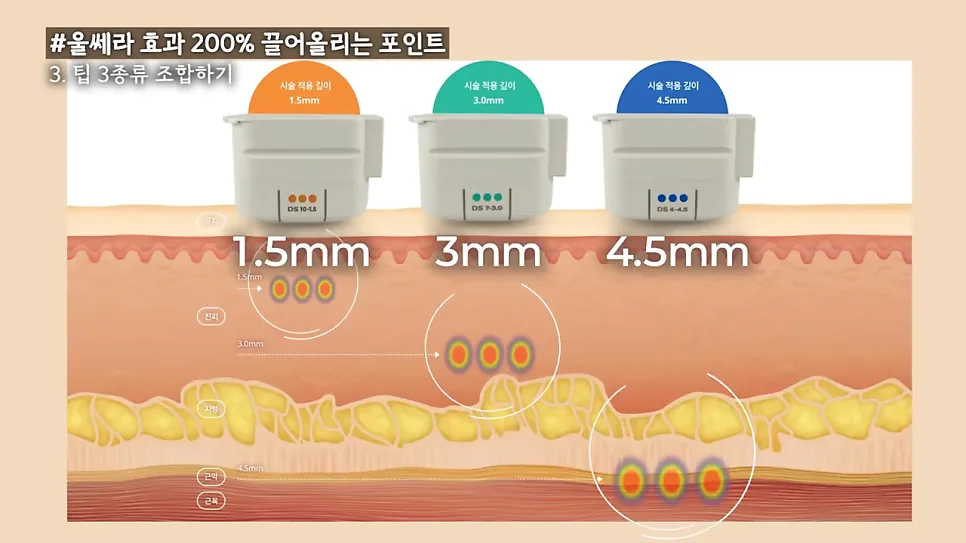
4.5 mm transducer: SMAS. The 4.5 mm transducer reaches the deepest layer, the SMAS. Because it targets the supporting SMAS directly, it's especially effective for lifting sagging skin and refining facial contours.
3.0 mm transducer: fat layer. The 3.0 mm transducer works on the deep dermis and the subcutaneous fat layer. That makes it a good fit for slimming sagging cheeks and a heavy jawline.
1.5 mm transducer: superficial dermis. The 1.5 mm transducer works on the thin dermal layer to support collagen production and improve fine lines, skin texture and pores. It's mainly used where the skin is thin, such as around the eyes and mouth.
“So even with the same Ultherapy, the results differ this much depending on the transducer.”
Exactly. That's why it's better to use all three transducers, even with slightly fewer lines, to lift, refine excess fat and improve the skin's surface in one session. Firmness lasts longer when every layer, from the surface to the dermis to the SMAS, is tightened together, like the layers of a sandwich. For example, 300 lines spread evenly across the three transducers can give a more three-dimensional lift than 500 lines with the 4.5 mm transducer alone.
Transducer Combinations Matter More Than Line Count
During lifting consultations at DAYONE Clinic near Gangnam Station, some people tell us, “I had 600 lines, and not much changed.” When we ask for details, they often had all 600 lines with the 4.5 mm transducer alone.

On the other hand, people who were happy with just 300 lines often had all three transducers used evenly. Don't judge by line count alone. Which transducers were combined, and how, matters much more.
Ultherapy After Fat Grafting
We also get asked, “I had fat grafting before. If I get Ultherapy, won't the grafted fat shrink and my cheeks hollow again?” No. Even if you've had fat grafting, Ultherapy can actually be more effective.
Sometimes only the grafted area sags, and Ultherapy can be focused on that area to improve firmness. It helps the grafted area blend naturally with the surrounding tissue.
However, wait until the grafted fat has fully settled before having a treatment like Ultherapy. If you have it before then, the fat can spread to other areas or decrease in volume.
Summary
Keep these points about line counts and transducer combinations in mind, and be sure to ask at your consultation, “Which transducers will you use, and how will you combine them?” In the next article, we'll cover energy level adjustments and the latest device in detail. If you have any questions, feel free to contact us.
This article is general information about the treatment and does not replace an individual diagnosis or treatment plan. Results and their duration vary from person to person.
Wondering what would suit you?
Whether a treatment suits you, and how to plan it, is best decided with a doctor.