

Easy-to-follow fascia massage steps 3 to 5 (midface, upper eyelids and scalp) for smile lines and drooping eyelids. We also explain why, if your skin has become thin and weak, we recommend building up its foundation with Rejuran before a lifting treatment.

This post is adapted from an interview on DAYONE Clinic's YouTube channel, Face Design Lab.
Hello from DAYONE Clinic. In the last post, I explained why the face sags and shared steps 1 and 2 of a fascia massage. This time, I'll go through the remaining steps 3 to 5 and take a closer look at Rejuran. The short answer: if your skin has become thin and weak, I recommend strengthening its foundation with Rejuran before a lifting treatment. If your skin is already firm, you don't need to have it first.
Step 3: Midface Massage
Step 3 releases the middle of the face, the midface. It helps with smile lines (nasolabial folds) and sagging cheeks. Start by pressing gently with your thumb right next to the side of your nose, where the smile line begins.
Then sweep softly upward from beside the nose, along the line of the cheekbone, toward your temple. Think of smoothing out a creased shirt with your palm. There's no need to press hard. Repeat on the other side, for about 30 seconds in total.
Easy, right? Done consistently, this movement helps stop the midface fat pads from sliding down and makes smile lines look less deep.
Step 4: Upper Eyelid Massage
Step 4 is a massage for drooping upper eyelids. As we get older, some of us feel our eyelids are heavier than before and opening the eyes takes more effort. Massaging around the brows and forehead to release tight muscles can make opening your eyes much easier.
First, use your thumb or index finger to press firmly on the inner end of your brow, as you would with acupressure. Small circular movements are fine too.
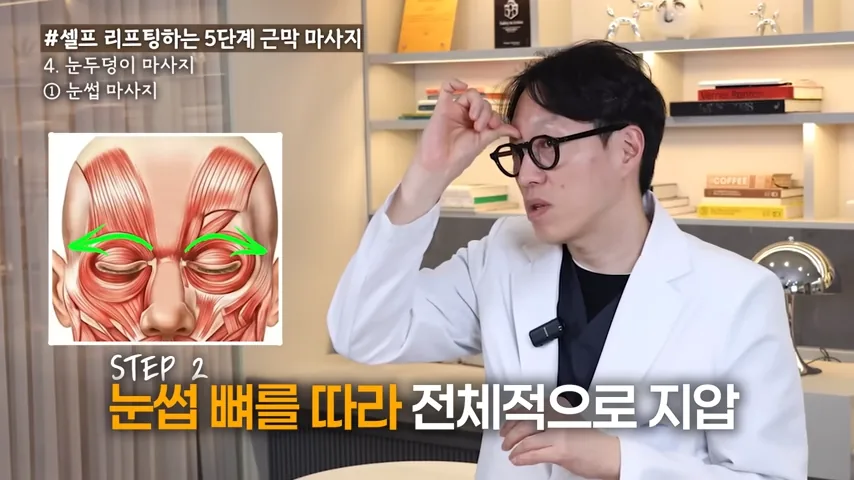
From there, work your way along the brow bone toward the tail of the brow, gently pressing to release the muscle. The skin around the eyes is very thin, so don't rub hard. Just press enough to feel the tension ease. Repeat for about 20 to 30 seconds.
Next, place the heel of your hand on the center of your forehead.
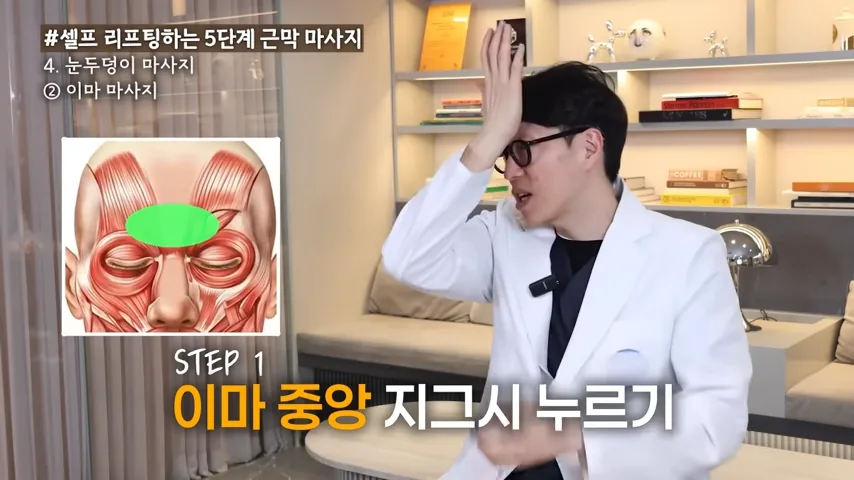
Pressing gently, slowly push upward toward your hairline. About ten times is enough.
As the tension in the fascia weighing down your brows eases, the eye area will look brighter and your eyes will open more easily. The frontalis, the forehead muscle, relaxes as well, which also helps keep forehead lines from deepening.
Step 5: Scalp Massage
The last step is a scalp massage that finishes off the lift. The skin of the face and the scalp are one continuous sheet. So no matter how much you lift the face, if the scalp holding it from behind is stiff, everything slides back down quickly.

Using your fingertips or knuckles, work firmly in circles over the temporalis area above your temples, where the hairline starts. Then press all over your scalp with your fingers, from the crown down to where it meets the back of your neck, to loosen it up. Do this for about 30 seconds as if you were drawing all your hair upward, and as your stiff scalp and neck muscles release, you may feel your whole face lift.

What Fascia Massage Can and Can't Do
Some people tell me, “That feels great. If I do it every day, even if it takes a while, will it really lift my face?” Massage is better at preventing sagging and maintaining how your skin looks now. If sagging is already advanced, though, the effect may feel minimal.

In that case, getting help from a treatment is faster and more efficient. That said, don't jump into a treatment just because others say it's good or because it's expensive and must be better. You could spend the money and end up with weaker skin.
Do You Need Rejuran Before Lifting?
There are three core treatments I recommend. Among them, if your skin has become very thin and weak, I suggest having a skin booster such as Rejuran before a lifting treatment.
You might be thinking, “Aren't skin boosters and lifting unrelated?” You're right. A skin booster doesn't usually lift the face directly.
Speaking honestly as a doctor, though, some people have skin that is far too thin, rough and sensitive. If they go straight to lifting without looking at the condition of their skin, the effect is weaker or fades quickly. That's true of any treatment.
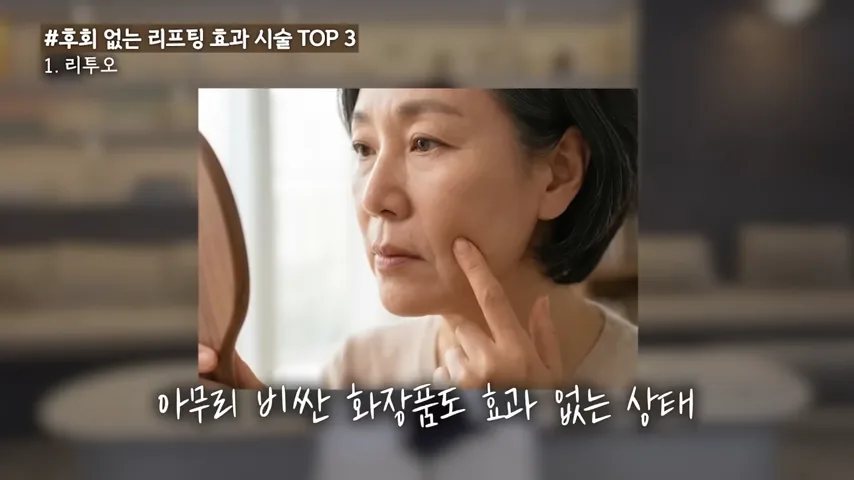
When your skin has had a bad flare-up, even expensive, high-quality skincare doesn't seem to do much, right? Treatments are the same. They work better and last longer on healthy, firm skin. That's why if your skin has weakened, I recommend Rejuran first.
What Is Rejuran?

Rejuran is often called a next-generation skin booster. It's an injectable that delivers PN (polynucleotides), purified from salmon DNA, into the skin. Put simply, this ingredient helps weakened skin repair and renew itself.
“But other skin boosters help skin regenerate too,” you might say. That's true. Other skin boosters certainly help.

The difference is that a typical skin booster mainly encourages the skin to regenerate on its own, while Rejuran is closer to setting up the environment that regeneration needs in the first place. In that sense it acts more directly. So people with thin skin and lots of fine lines, or whose pores have stretched vertically as elasticity drops, often find their skin feels firmer and thicker after two to four Rejuran sessions.
Changes You Can Expect From Rejuran
Fine lines, pores, dryness and firmness all improve visibly together, so two or three months after Rejuran, some people hear things like “Did something good happen? You look younger.” Above all, when you build a healthy skin foundation first and then have a lifting treatment, the treatment can be done more reliably and you can expect a clearer result.
Summary
Remember fascia massage steps 3 to 5 (midface, upper eyelids and scalp), and why building your skin's foundation with Rejuran before lifting makes sense. In the next post, I'll cover Ultherapy and thread lifts in detail. If you have any other questions, feel free to contact DAYONE Clinic at Gangnam Station.
This article is general information about the treatment and does not replace an individual diagnosis or treatment plan. Results and their duration vary from person to person.
Wondering what would suit you?
Whether a treatment suits you, and how to plan it, is best decided with a doctor.