

Under-eye sagging falls into three types: protruding under-eye fat, loss of skin elasticity and a hollow tear trough, and each has a different cause and solution. Find out your type first with four self-tests you can do at home with just a mirror.

This article is adapted from an interview on DAYONE Clinic's YouTube channel, Face Design Lab.
Hello from DAYONE Clinic. In the previous article, we explained that proper moisturizing and puffiness control matter more than expensive eye cream. This time, we'll go through the types of under-eye sagging and how to check yours at home. Under-eye sagging comes in three types: protruding fat, loss of skin elasticity and tear trough hollowing. You can tell them apart at home with four tests: rolling your eyes, lying down, pinching the skin and shining a light.
Types of Under-Eye Sagging
Under-eye sagging may look similar from the outside, but it can actually be completely different types. Each type has a different cause, and so a different solution. The three main causes are:
Protruding type, where under-eye fat bulges out
Laxity type, where the skin has lost elasticity
Tear trough type, where the tear trough has hollowed
Type 1. When Fat Has Pushed Forward
Of all the types, this is the one we see most often in clinic.

Inside the eye socket is a cushion of fat that protects the eye: the under-eye fat. When we're young, the orbital septum, a thin wall that holds this fat in place, is strong and keeps the fat inside. With age, this wall weakens and loosens. The fat it was holding back gradually pushes forward and downward, and as a result, it shows as a puffy pouch under the eye.
Even at a young age, under-eye fat can protrude because of your natural facial bone structure. That's why some people in their 20s already have puffy under-eyes.
This type is hard to cover with makeup, and no matter how much eye cream you apply or how hard you massage, it barely changes. Fat that has already pushed out can't be pushed back in or melted away with those methods. In fact, the wrong home care can cause pigmentation and make the under-eye area look even darker.
Type 2. When the Skin Has Thinned and Lost Strength
The second type, the laxity type, is when the under-eye area sags not because of fat but because the skin itself has become thin and weak.
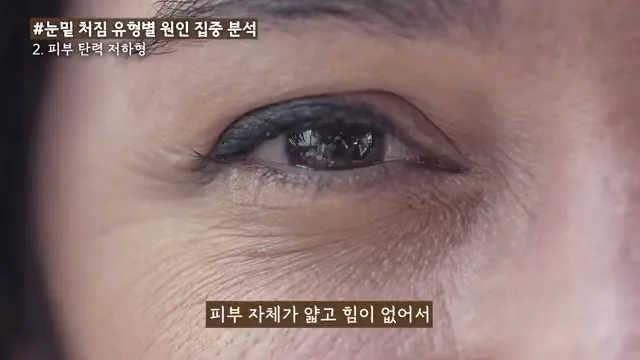
With age, collagen decreases and sun damage builds up, and when you're short on sleep or your skin barrier weakens and dries out, the skin around the eyes gradually thins. The surface becomes crinkly, and dense fine lines can show up under the light. Lines that deepen when you smile or make expressions, and foundation settling into the lines, are signs of this type.
Because the cause lies in the skin itself, moisturizing, sun protection and skin boosters or radiofrequency treatments such as Thermage, which firm the skin itself, are a good fit.
Type 3. When Volume Under the Eyes Has Hollowed
The last type is when the under-eye area sinks in and casts a shadow, commonly called the tear trough type.
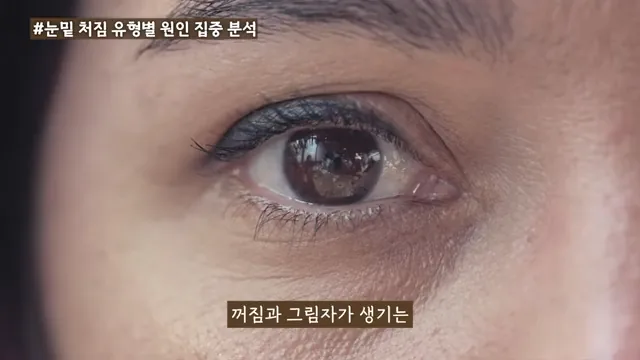
It's the opposite of the protruding type, where fat pushes forward. It can look like sagging at first glance, but it's actually caused by the loss of the volume that supported the area under the eye. With age, fat in the middle of the cheek, the midface, naturally decreases or slides down with gravity.
Normally, the under-eye area and the cheek should flow smoothly like a gentle slope, but when the lower volume disappears, the area right under the eye becomes empty. That makes the under-eye fat above stand out more, and the boundary shows up like a deep line.
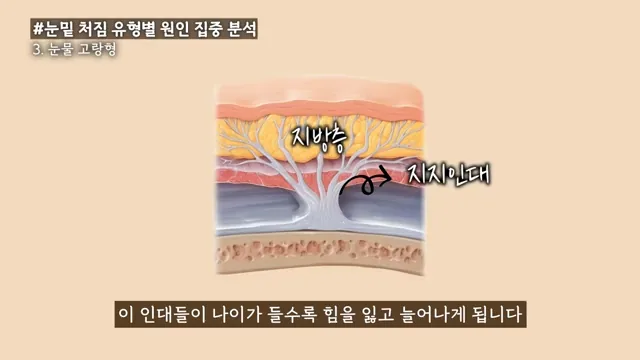
The face also has retaining ligaments that hold fat in place, and these ligaments lose strength and stretch with age too. As a result, the fat sags further and the tear trough deepens. On top of that, the bone supporting the area under the eye is gradually resorbed with age and recedes.
In short, even though the tear trough type looks like sagging skin, it's really a change caused by emptiness underneath, so home care alone has clear limits here too.
Four Tests to Try at Home
“I'm not sure which type I am. Is there an easy way to check on my own?”
Let's go through four methods one by one. You can try them right away in front of a mirror.
Test 1: Eye-Roll Test

Place a mirror slightly below your chin rather than at face level. Without moving your head, look down at the mirror with only your eyes.
Then slowly roll your eyes up to look straight ahead. If the puffy pouch under your eyes bulges out more than usual, it's very likely caused by fat.
This means the fat pouch inside the eye socket, the under-eye fat, has pushed outward. For these patients, there are clear limits to what cosmetics or massage can do, because fat that has structurally pushed out can't be put back that way.
Test 2: Lying-Down Gravity Test

This test is most accurate lying down. Some people's under-eyes look puffy and shadowed when they look in a mirror standing up, but flat when they lie on their back and look into a mirror.
If so, the good news is that it's still a good time to manage it. You don't have a lot of fat; the skin has lost some elasticity, and gravity has pushed the fat out slightly. Often, a simple fat-dissolving injection, firming care or a lifting treatment alone can make a noticeable difference.
On the other hand, if the puffiness stays the same when you lie down, the fat has already increased quite a bit, and home care alone has clear limits.
Test 3: Skin Pinch Elasticity Test

Gently pinch the skin under your eye between your thumb and index finger for about three seconds. If the skin snaps back right away after you let go, its elasticity is still fairly good.
If the skin returns very slowly or a crease stays for a while after you let go, elasticity has already dropped a lot, to the point of sagging.
As explained above, this is more about the skin itself having thinned and stretched than about fat. For these patients, treatment to restore elasticity comes first, so while home care matters, you really should get help from in-clinic treatment.
Test 4: Light and Shadow Test

The last test, the shadow test, checks for tear trough hollowing. It's a good way to tell protruding fat from a hollow tear trough.
Look in a mirror by a window, or turn your face at an angle under a light. Raised areas catch the light and look bright, while hollow areas fall into shadow and look dark.
If the area under your eyes is shadowed like dark circles and concealer doesn't cover it well, it's very likely a structural hollow, a sunken tear trough, rather than pigmentation.
You can also gently push up just below the tear trough with your finger. If the shadow disappears and the area looks smooth when you push up, it's likely the hollow type. If the puffiness remains even when you push up, it's closer to the protruding fat type than the hollow type.
The tear trough type is also hard to fix with eye cream or massage. But be careful: rushing into under-eye surgery that simply removes fat, instead of fat repositioning, which shifts the fat into the hollow tear trough, can make the under-eye area look even more hollow.
Summary
Use the four self-tests in this article to find out which type your under-eye area is, and get a sense of what it would take to improve it. In the next article, we'll go into the treatments that suit each type. If you have any questions, feel free to contact DAYONE Clinic near Gangnam Station.
This article is general information about the treatment and does not replace an individual diagnosis or treatment plan. Results and their duration vary from person to person.
Wondering what would suit you?
Whether a treatment suits you, and how to plan it, is best decided with a doctor.