

As we age, collagen in the dermis declines, and both the fat layer and the fascia (SMAS) slide downward, so the contours of the face lose their definition. Here’s a layer-by-layer guide to which lifting treatments to consider for the skin, the fat and the fascia.
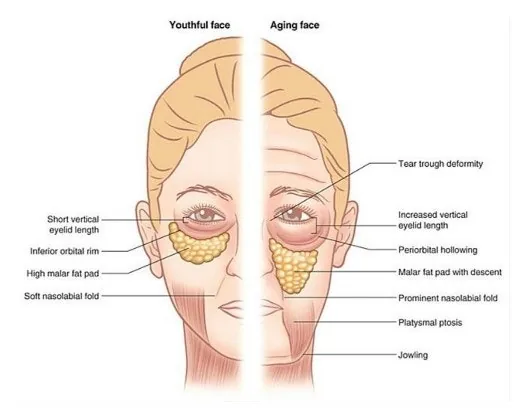
Everyone wants to slow down aging and hold on to a youthful, firm look. But by your late twenties you can already feel it starting, and somewhere past thirty you realize you’re sighing at the mirror more often than you used to. That’s why, if I had to name the “crown jewel” of aesthetic treatments, I’d pick lifting. It works against both gravity and time.
These days, all kinds of people come in asking about lifting, from patients in their twenties to those in their sixties and seventies. Twenty-somethings (mostly in their late twenties) often show up a little alarmed after noticing that aging has “started,” while older patients tend to come in after seeing friends who suddenly look younger, or because their grown children brought them. Lately, interest in lifting seems to have grown even more, thanks to news stories about certain high-profile figures whose clocks seem to be running backward.
Why does the face sag with age?
So why does the face lose its firmness, and why does it age and droop over the years? The illustration above shows the process simply and clearly. On the left is the face in youth; on the right is the face once aging has set in and the contours have started to lose definition and sag. As you can see, a number of anatomical structures change as we get older.
What changes in each layer, from skin to fascia
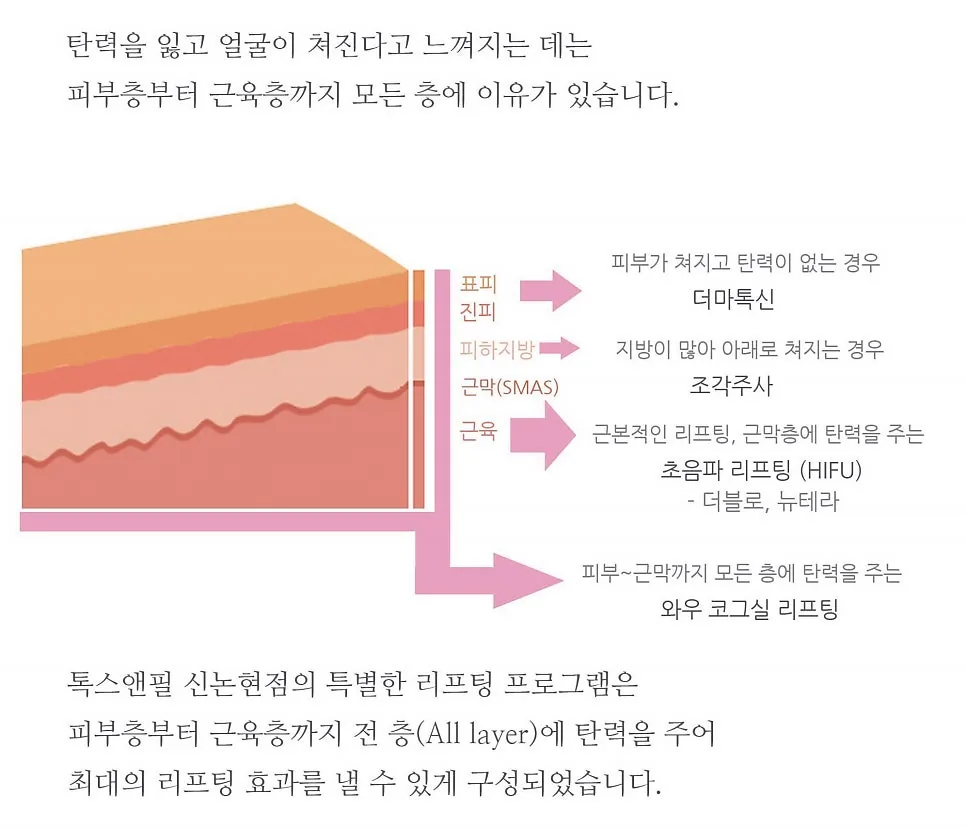
The illustration above comes from our clinic’s lifting brochure.
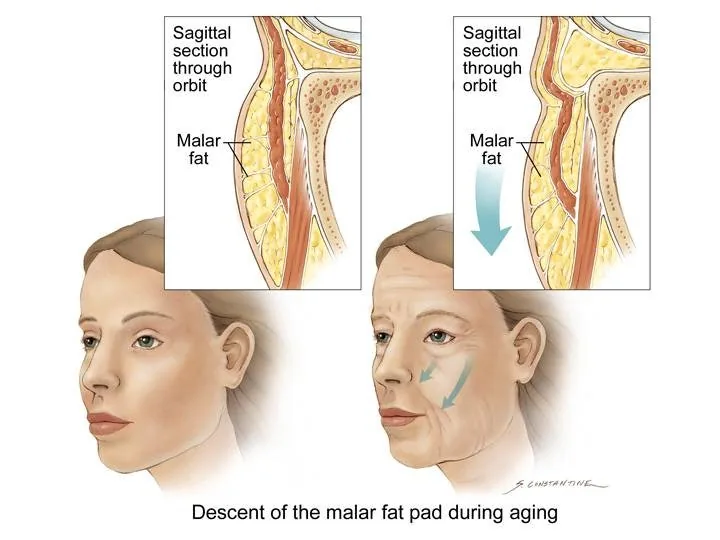
From the surface inward, the skin is made up of the epidermis and the dermis, with a layer of subcutaneous fat underneath. Below the fat lies muscle—and as we age, all of these layers are pulled downward by gravity.
Collagen in the dermis decreases with age. Think of collagen as a support structure: as that support thins out, the skin starts to sag, and the fat beneath it sags along with it. Fat also tends to increase with age, and as the skin above it droops, the fat layer itself slides downward. In the illustration just above, you can see the fat (yellow) moving down over time, while the SMAS layer, shown in red, also loses its elasticity and drops.
SMAS stands for superficial musculoaponeurotic system. Put simply, it’s the fascia that wraps around the facial muscles. The SMAS is the most important structure in lifting—it’s also the layer surgeons target in a surgical facelift.
Lifting treatments by layer
When planning a lifting treatment, consider the following:
When the skin has lost elasticity—micro-Botox (dermotoxin), or treatments that stimulate new collagen in the dermis (RF microneedling, Fraxel, thread lift)
When excess fat makes the face sag more—fat-reducing treatments such as fat-dissolving injections; ultrasound lifting (HIFU) can also reduce fat to some extent. A thread lift can also pull a sagging fat layer back up.
To restore firmness to the fascia—a facelift (surgery), which lifts the SMAS layer, or ultrasound lifting (HIFU) and thread lifts, which can also reach and lift the fascia.
The bottom line
For younger patients focused on prevention, there’s no need to do everything—targeting the layer that’s causing the problem is enough. But as aging progresses, lifting works best when every layer is addressed. That’s why there are so many different treatments, and why any single treatment on its own can only go so far. That wraps up this overview of lifting; in upcoming posts, I’ll go into each topic in more detail.
This article is general information about the treatment and does not replace an individual diagnosis or treatment plan. Results and their duration vary from person to person.
Wondering what would suit you?
Whether a treatment suits you, and how to plan it, is best decided with a doctor.